Why Recovery Is Performance Infrastructure
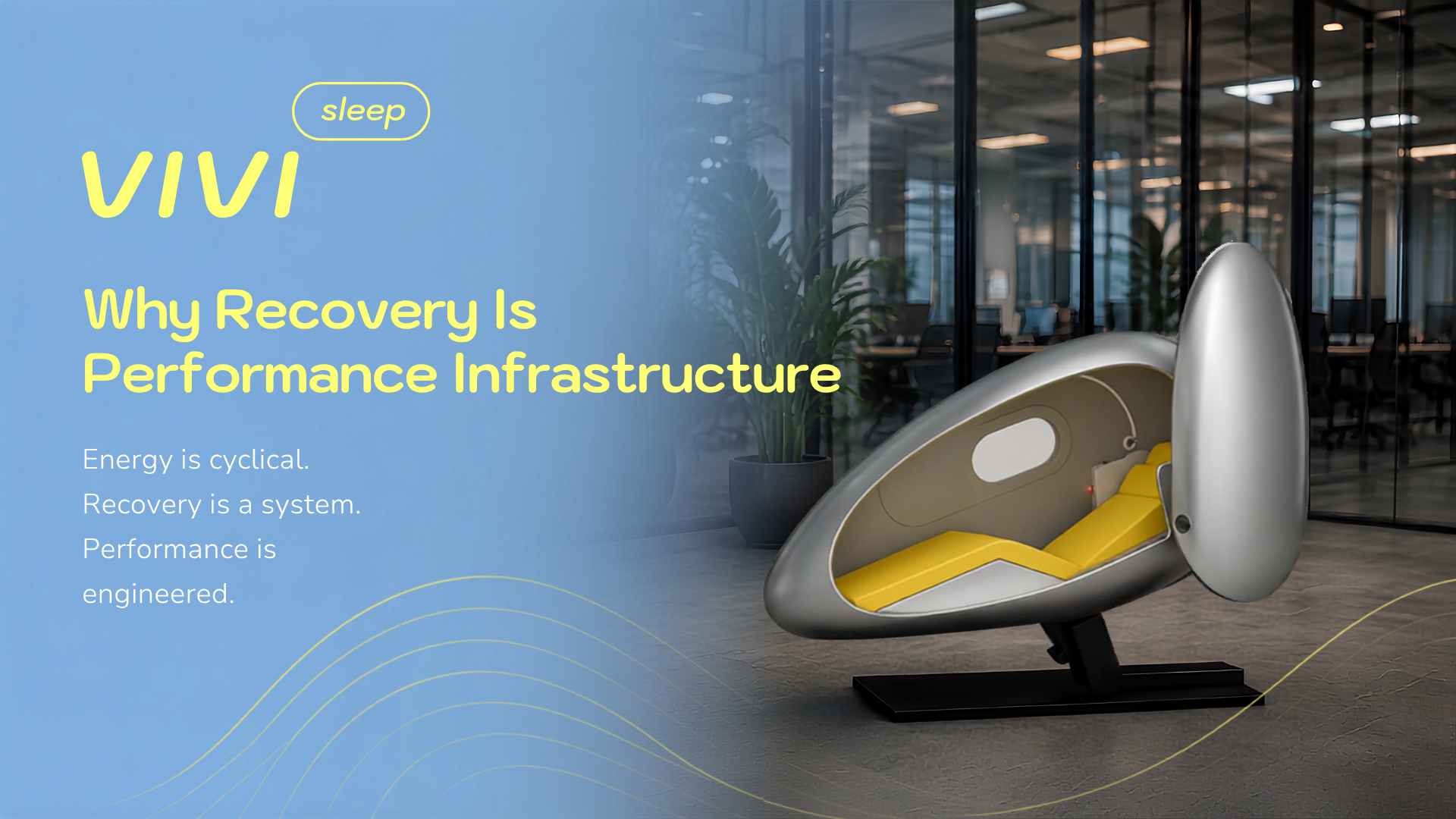
VIVI is built on a simple premise with a large body of research behind it. Performance is not a function of how long you work. It is a function of the energy you have available while you work, and that energy moves in a predictable, measurable, and ultimately manageable pattern across every single day. This is the same science behind why structured workplace recovery, from dedicated break policies to on-site sleep pods, is gaining traction across Dubai's corporate sector.
This is the case for that premise, brought together in one place.
Energy is cyclical, and that is good news
The early afternoon dip in focus that almost everyone feels is not caused by lunch. It is caused by the circadian rhythm, the internal clock that produces a natural, biologically scheduled low point in alertness, typically between 1pm and 3pm, layered on top of sleep pressure that has been quietly building since the moment you woke up.
The useful part of this is that it is not random. A pattern that is predictable is a pattern you can design around. Once energy is treated as a cycle rather than a flat line that should hold steady from 9am to 6pm, the entire structure of a working day opens up to be rebuilt around something real instead of something assumed.
Pushing through the dip costs more than it saves
The instinct when energy drops is to push harder. The research says this trades a short-term feeling of progress for a longer term decline in quality. Reaction time slows, focus becomes unstable, and decision making weakens, even while the hours worked keep climbing. Past a certain point, more effort does not produce more output. It produces more rework, more small errors, and more inconsistency in the work that follows.
High performers do not try to eliminate the dip. They manage it, choosing when to push and when to reset, because the actual goal was never to stay busy. It was to stay effective.
Recovery is not one thing. It is three
Fatigue is not a single, undifferentiated state, which is why a single, undifferentiated fix rarely works. There are three distinct systems that deplete and recover on their own timelines.
Physical recovery restores the body, the muscles, the nervous system, the postural load that builds even from sitting through back-to-back meetings. Mental recovery restores decision making capacity and emotional regulation, and requires genuine disengagement from cognitive demand, not a different kind of input. Cognitive recovery restores focus, processing speed, and working memory, and responds specifically to a reduction in sensory load rather than rest in a general sense.
Most environments are built around one of the three, occasionally two. Designing for all three at once, in a single structured session, is the foundation VIVI is built on.
What is happening inside the brain, and why it is fixable
Two mechanisms drive most of what gets felt as an afternoon decline. Adenosine accumulates from the moment you wake up and keeps building the longer you are active. Caffeine does not reduce it. It blocks your ability to feel it, which is part of why the crash that follows a coffee often lands harder than the fatigue it was masking.
The more consequential mechanism involves the prefrontal cortex, the region responsible for judgment, planning, and impulse control, and the most metabolically expensive part of the brain, which makes it the first to lose capacity under sustained load. Researchers estimate the average person makes somewhere between 200 and 300 meaningful decisions in a working day, and quality degrades measurably as that number climbs without a reset. The decline does not feel like impairment from the inside. It feels like pragmatism, which is exactly what makes it easy to miss.
The reassuring part is that this entire cascade, adenosine building, cortisol rising, prefrontal capacity narrowing, is well understood and directly reversible with the right conditions. It is biology with a known solution, not a personal limitation.
Precision recovers more than duration ever will
Once the mechanism is clear, the next question is how to actually use it. The answer is dosage, not effort.
A nap that runs 10 to 20 minutes stays inside the lighter stages of sleep and restores focus cleanly. Push past roughly 25 to 30 minutes and the likelihood of sliding into deep sleep rises sharply, producing sleep inertia, the groggy disorientation that can leave you worse off than if you had not rested at all. The same logic applies to combining tools rather than choosing between them. A coffee taken immediately before a short nap uses the timing of caffeine absorption to land just as the nap ends, producing a more complete recovery than either tool delivers on its own.
The lesson underneath all of it is the same. More is not automatically better when it comes to recovery. Precision is.
Why a 20 minute power nap works, specifically
Put the sleep architecture, the adenosine curve, and the cortisol response together and they converge on the same window. The shift toward deep sleep begins around 20 to 25 minutes after onset, which sets the outer edge before sleep inertia becomes a risk. Adenosine clearance is front loaded, meaning most of the available reduction happens in the first phase of rest, before deep sleep begins. Cortisol, the hormone that keeps the brain in reactive mode, drops measurably within minutes under genuine sensory reduction.
The data backs this from very different fields. NASA's research on pilot napping found that a 26 minute nap improved performance by 34 percent and alertness by 54 percent compared with no rest at all. The US Army's own sleep management research found that a single short nap every 24 hours cut the rate of cognitive degradation from 25 percent per day to 17 percent. A more recent field study, published in the Quarterly Journal of Economics, tested the same idea outside of aviation and combat settings entirely: office workers offered a 30 minute afternoon nap saw a measurable productivity gain across the full workday. Different contexts, same underlying window.
Twenty minutes is not a compromise. It is the point where the research says recovery peaks.
What actually comes back
The payoff is concrete enough to name directly. Focus returns first, often within the first hour, showing up as faster task completion and fewer false starts. Decision quality follows closely, as a rested prefrontal cortex evaluates options more carefully instead of defaulting to the easiest one. Emotional regulation comes back with it, widening the gap between a triggering moment and a reactive response, which is the difference between the sharp reply and the considered one. Error rates drop in ways that are rarely tracked but compound meaningfully across a week. And stamina for the rest of the day extends, because the decline that would otherwise run in a straight line restarts from a higher point.
None of this asks for belief. It asks for twenty minutes and the right environment.
Why VIVI is built this way
Put all of it together and the argument is straightforward, even where the biology behind it is not. Energy, not time, is the input that determines performance. That energy runs in cycles with a known, recoverable low point. The fix is not longer rest or more willpower. It is a precise, structured reset that addresses the body, the mind, and cognitive capacity at the same time, for exactly as long as the research says it should take.
That is not a wellness idea. It is closer to an engineering specification, and it is the one VIVI has been built around from day one. Twenty minutes. The right environment. All three systems addressed at once. The hardware side of that specification is covered in what's actually inside a VIVI pod, and the wider category in our guide to sleep pods in Dubai.
Today, that specification takes shape in three ways. As standing infrastructure inside workplaces across Dubai, available to a team the same way a meeting room is. As on demand recovery at events, conferences and exhibitions, where energy tends to collapse fastest on the second day. And as accessible sessions in public and shared spaces, open to anyone who needs twenty minutes between one part of their day and the next. The format changes with where you meet VIVI. The twenty minutes, and the science behind it, does not.
Performance was never only about effort. It was always also about recovery, treated with the same seriousness as the work itself.
Frequently asked questions
Related reading
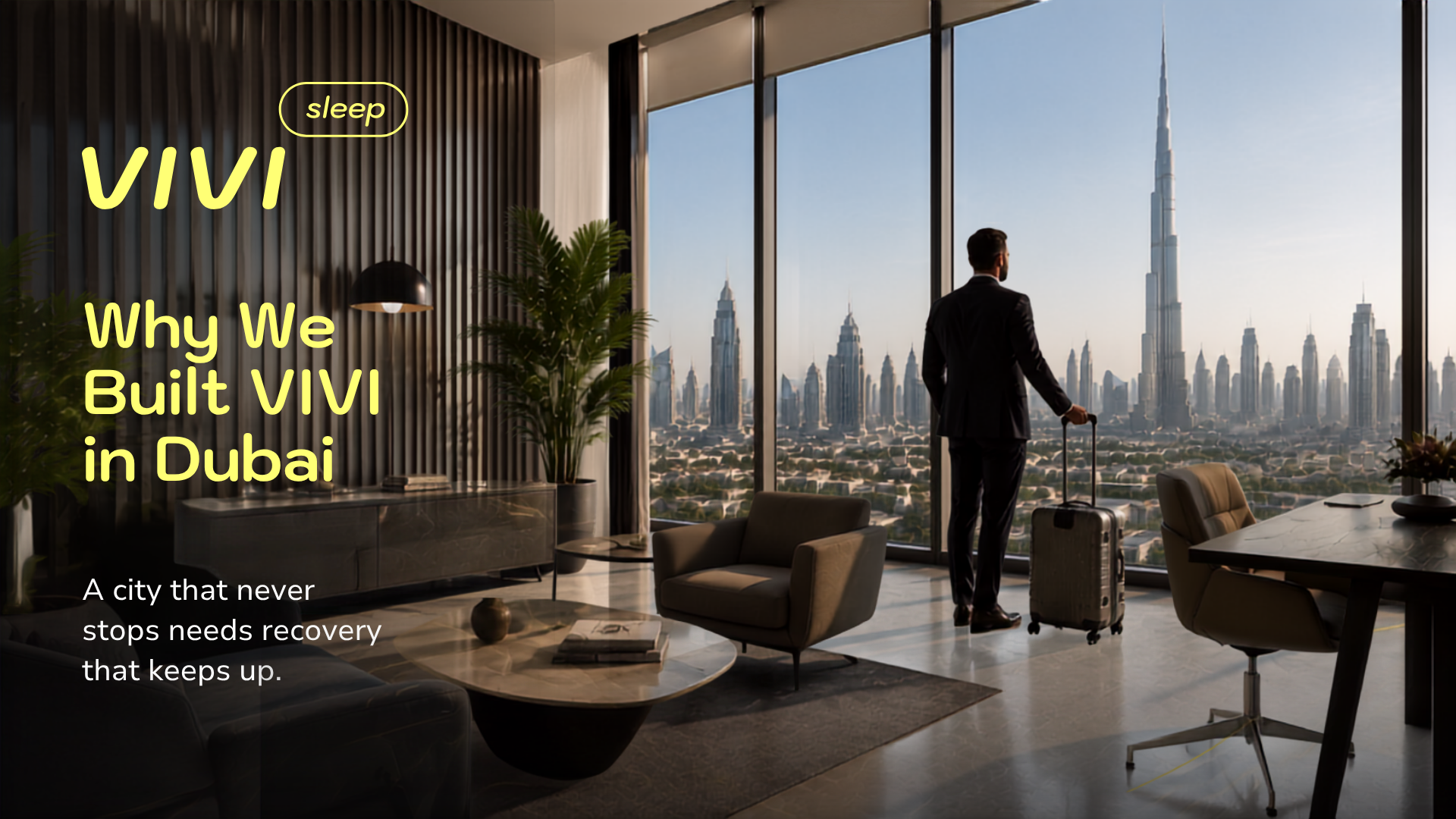
Why We Built VIVI in Dubai
The data behind Dubai's work culture, and why recovery had to become infrastructure.
Read article →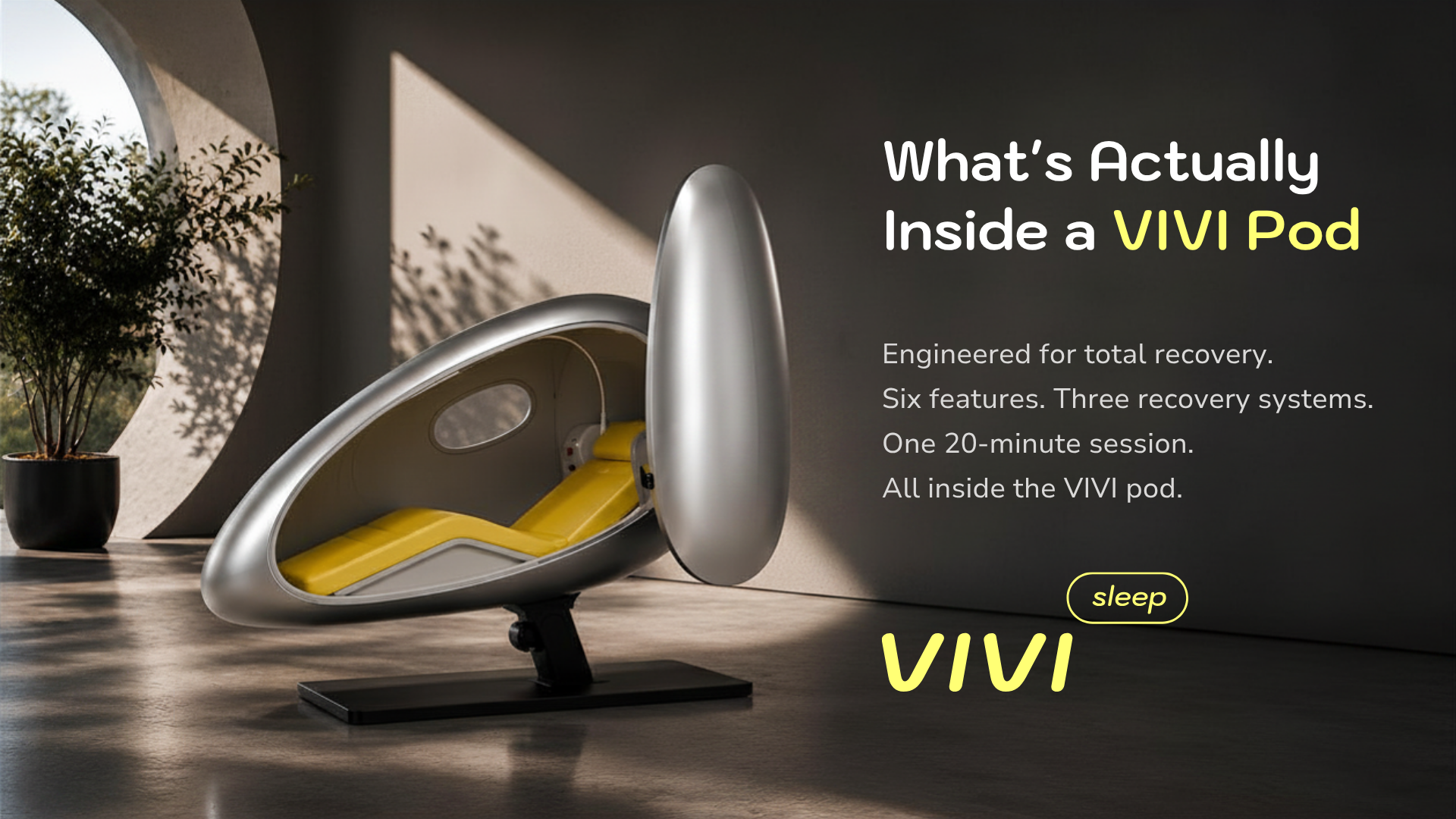
What's Actually Inside a VIVI Pod
The engineering behind every VIVI session: six features designed to deliver physical, mental, and cognitive recovery in a single twenty-minute window.
Read article →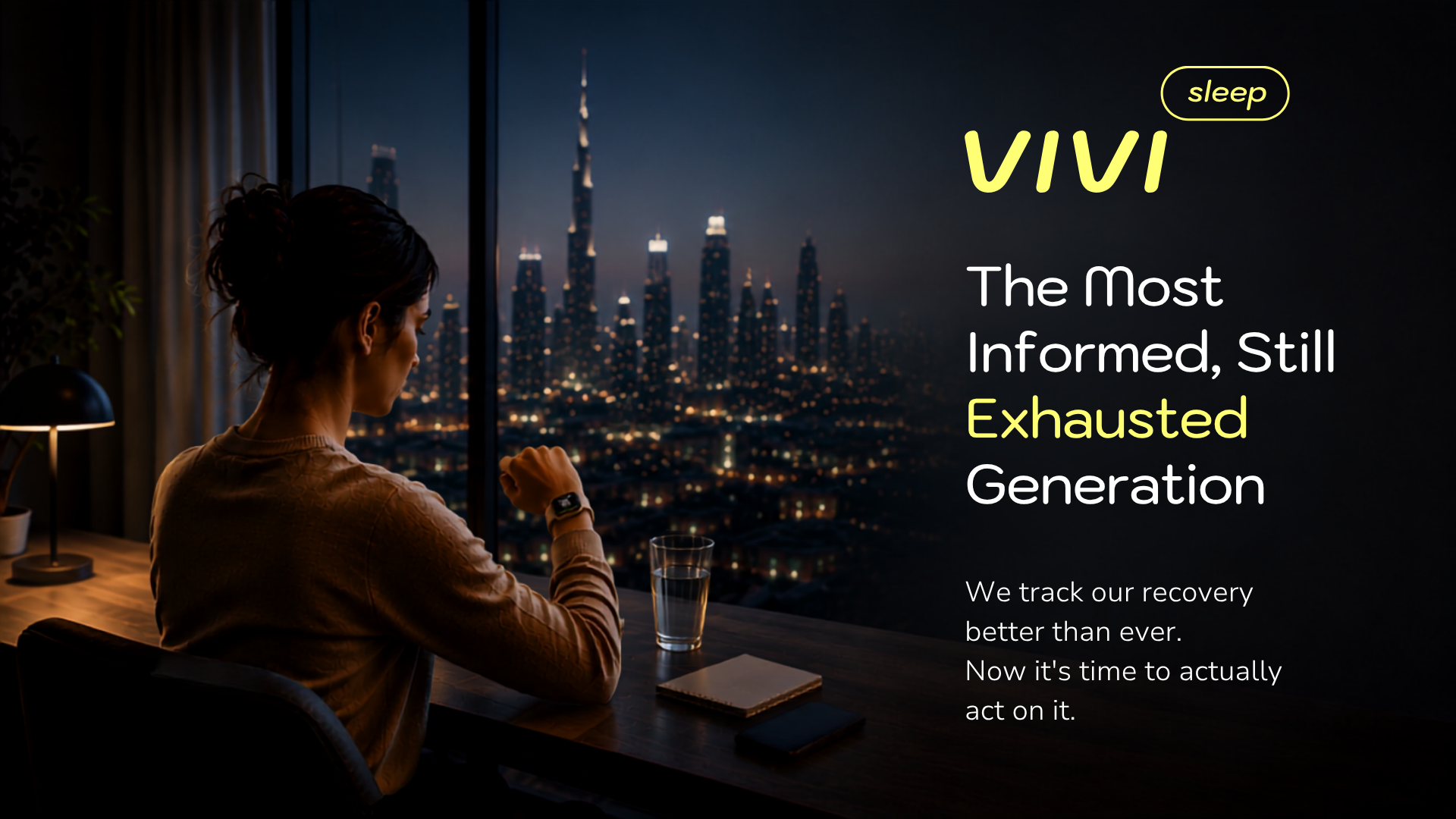
The Most Informed, Still Exhausted Generation
Wearables finally put a number on how tired you are. Here's the part they were never going to solve.
Read article →Explore VIVI solutions
Workplace, event, or public space. Find the right recovery infrastructure for where you are.
Explore VIVI solutions